Daggertail
A compact, pointed tip.Think of a dagger-shaped outline. The illustration identifies the shape, not its exact scale.
Find recorded dragons →Currently exploring Fourth Wing and The Empyrean.
Know the lore. Keep the wonder.
To understand Fourth Wing dragon types, separate a dragon’s color from its tail shape and individual identity. Start with the six foundational colors and the tail terms below; later story details follow your reading progress.
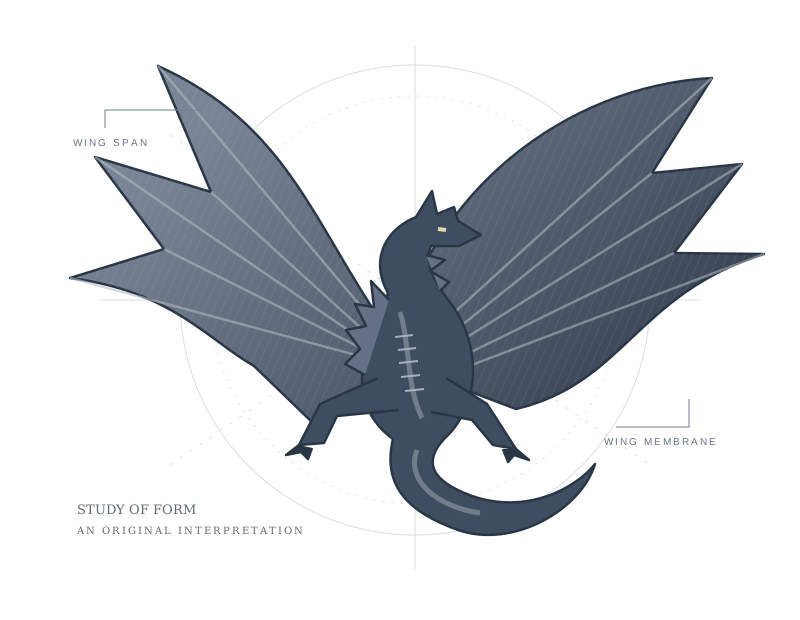 Field study · Interpretive illustration
Begin with black, blue, green, red, orange and brown. Color descriptions are starting points, not complete personality profiles.
Discerning & elusive
↗Formidable & ruthless
↗Measured & rational
↗Quick-tempered
↗Unpredictable
↗Steadfast & loyal
This is the introductory color framework. Later explanations are kept behind your reading settings.
Six commonly discussed tail terms, shown as original identification diagrams. Shapes are illustrative, not to scale.
Think of a dagger-shaped outline. The illustration identifies the shape, not its exact scale.
Find recorded dragons →The spikes distinguish it from a smooth club silhouette. The name refers to the weapon, not a star-shaped dragon.
Find recorded dragons →Compare the longer blade silhouette with the more compact dagger shape.
Find recorded dragons →A scorpion-like outline does not establish venom chemistry. This guide makes no claim about toxins.
Find recorded dragons →The rounded end is the visual distinction. No invented damage or armor-piercing statistics are assigned.
Find recorded dragons →This term needs extra context. Open the dedicated guide at your reading level rather than treating it as another color.
Understand feathertails →A note on Feathertail: do not count a tail term as another color. Its full meaning needs story context. Read the progress-aware explanation →
A description can contain several kinds of information. Identify what each term describes before drawing conclusions about the dragon.
| Descriptor | What it identifies | What it does not establish |
|---|---|---|
| Color | A color group or den, such as blue or brown. | A fixed tail shape or rider ability. |
| Tail | A shape described by terms such as swordtail or clubtail. | The dragon’s color or a numerical combat rating. |
| Individual | A named dragon with particular relationships and choices. | A universal rule for every dragon in its color group. |
This section includes details from Fourth Wing. Change your reading progress when you’re ready.
Tairn is a Black Morningstartail. The color and tail are separate parts of the description.
Sgaeyl is a Blue Daggertail. Her rider connection is another fact, not a definition of all blue dragons.
Open a character’s field notes or search the curated directory. Connections and abilities respect your reading progress.
A guide to his name, identifying features, and place in the story.
Open the field notes ↗Identify her color and tail, then explore the rider connection at your own pace.
Open the field notes ↗A reading-progress guide to a dragon whose description needs context.
Open the field notes ↗Browse the dragon & rider directory → · A curated collection, not an exhaustive list.
The introductory framework includes six color groups: black, blue, green, red, orange and brown. Six commonly discussed tail terms describe a different dimension. Do not add the two lists together as a count of species; later context is revealed as the story progresses.
No. Color identifies a group, while a tail term describes a physical shape. Treat them as separate descriptors and check a named dragon’s record for a particular combination.
Feathertail is not a color label. Its story context is explained in the dedicated guide, where later information follows your reading progress. Explore the Feathertail guide →
This guide does not use a fixed color-to-signet mapping. A rider’s recorded ability is not a rule for every dragon of that color. Use the dragon and rider directory to check the individual connection.
Keep the reading setting at “Just starting” for the basic classification guide. Only choose a completed book when you are ready to reveal its character details. External references may contain later spoilers and do not follow your setting.
These introductory explanations use the references below. We distinguish sourced descriptions from original illustrations and fan activities; the collection has not undergone a full chapter-by-chapter primary-text audit.